
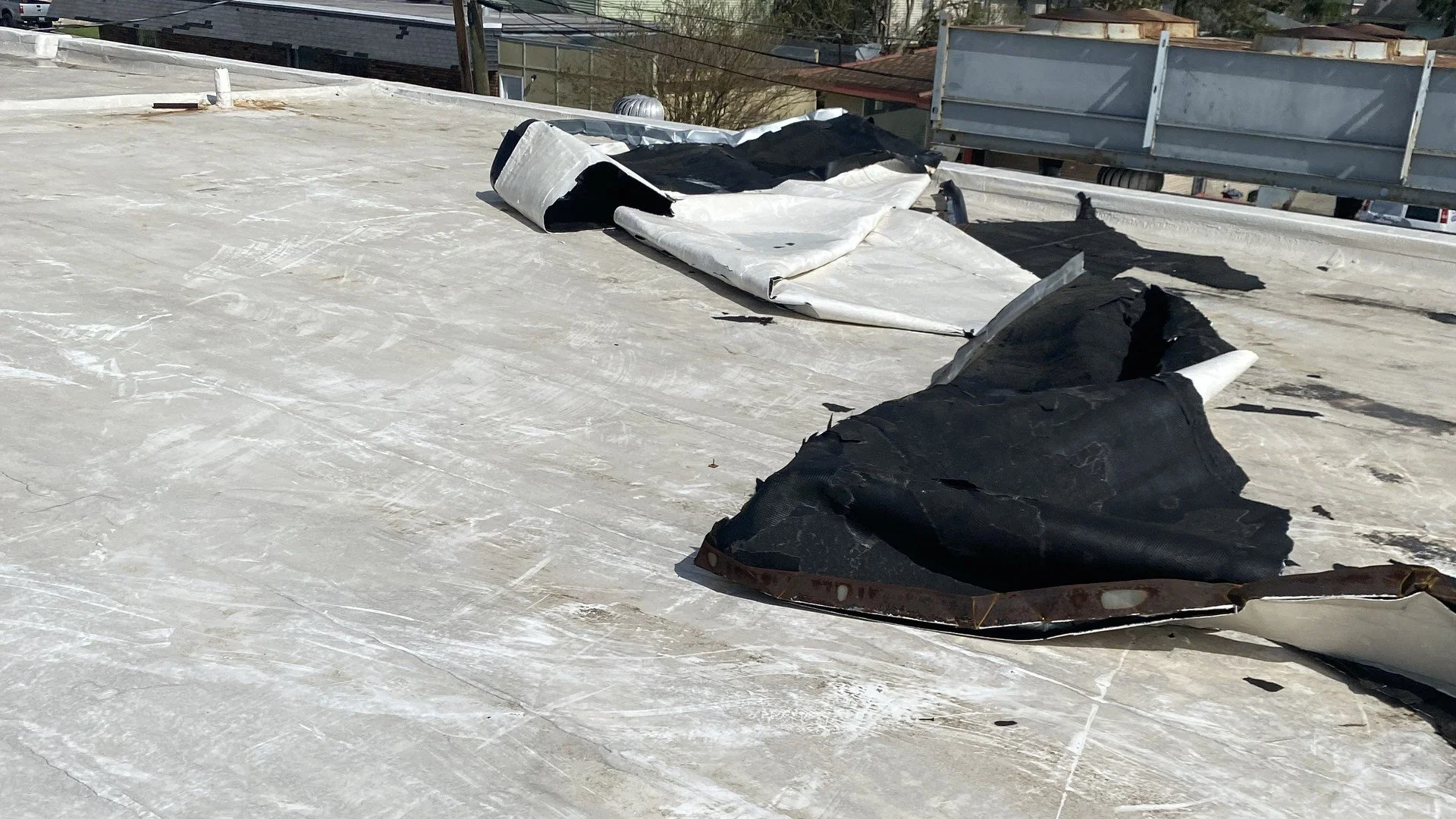
"I don't feel like the roof should be replaced."
That's what the carrier's appraiser wrote about the roof on a Hurricane Ida claim we handled at a retail strip center in Louisiana. The carrier's first number was $201,896. The building claim resolved at $1.4 million.
Three things stood between those two numbers: an exclusion, an opinion, and an examination under oath. Here's how each one was answered.
The claim
The owner reported the loss the day Ida hit. A field adjuster inspected twice in September. After that, nothing for eight weeks: no estimate, no payment, no coverage position.
The owner's son is a contractor. He walked the building and could see the insurance response didn't match the damage. The roof was ripped open, and water had poured through the tenant spaces. He told his mother to call us.
This wasn't a single-policy claim. The center had several commercial tenants. The owner's policy covered the building, and each tenant carried its own coverage. The largest tenant, a supermarket, had lost refrigeration, inventory, fixtures and the use of its space, and it hired us too. Using the leases as the guide, we sorted the loss so every dollar landed under the right policy, once: building and landlord improvements under the owner's policy; trade fixtures, business personal property, and tenant improvements under the tenant's; lost rent and lost business income each under its own coverage.
Once we were involved, the carrier moved. Within a week of our letter of representation, its adjuster asked to meet us at the property. We inspected together in early November and submitted our estimate the next day. Four weeks later the carrier issued its first determination: $201,896.
We call that a compliance estimate. It meets the deadline. It rarely captures the loss.
1. The exclusion: how the carrier cut the claim down
The carrier leaned on one endorsement, an Exclusion of Existing Damage. The operative language:
> This policy does not provide coverage for physical loss or damage which occurred prior to policy inception. … We pay for direct physical loss or damage to covered property by a covered cause of loss only if the structures covered by your previous policy have been fully repaired.
With that endorsement, the carrier excluded the grocery's floor tile and the deli's walls and floor as "long term" damage. It used the roof's age and condition to cut the roof scope down to coatings and patches.
Nobody suggests a carrier should pay to replace damage that existed before the policy. That was never the argument. The argument was about what the storm did to this building. Ida's winds peeled roofing off. Wind-borne debris struck the bitumen membrane that was left. Water got under the membrane, saturated the insulation, and poured through the tenant spaces. That damage was new, and it was Ida's.
The exclusion also set up a second problem. A replacement cost policy works in two steps. First, you price what the storm requires. Second, you deduct depreciation for the property's age and condition. Age belongs in that second step, once. What the carrier did was use the exclusion to shrink the scope because of age and condition, and then depreciate what was left for the same age and condition. That's charging the owner twice for the same thing. It's double depreciation.
2. The opinion: "I don't feel like the roof should be replaced"
The carrier's appraiser priced metal panels and a silicone coat over the flat roof. Nothing was included for the main roof's membrane or the wet insulation underneath it. In writing, he put his position this way: "I don't feel like the roof should be replaced."
A feeling isn't a scope of work. It's an opinion, and an opinion gives way to evidence.
The evidence was physical. A roof in that condition can't be patched. A patch won't bond to wet, aged membrane. Wet insulation under a roof has to come out, and once it does, the membrane comes off with it. The storm damage is what required replacement, not the roof's age.
And the evidence was documentary. To beat the exclusion and the opinion together, we had to prove two things: the building had been maintained, and any earlier damage had been fully repaired before Ida. The owner had the records to prove both, and the next section is how they got used.
When the dispute reached appraisal, the documentation won. The umpire awarded a full tear-off and replacement of 33,266 square feet of roof, worth $508,497 at replacement cost. He handled the roof's age the right way, with $176,610 of depreciation, and wrote that he was "comfortable with the depreciation as applied to the roof." Age was deducted once.
The carrier's appraiser still didn't "feel" it. Two of the three panel members signed anyway.
3. The examination: an 80-year-old owner, under oath
Three weeks after its first determination, the carrier's attorney sent the owner a notice of examination under oath. The owner is an 80-year-old woman.
The letter made no allegation of fraud, misrepresentation or late notice. It said only that the carrier was "investigating the claims while reserving all of its rights." What it did do was ask for a lot: 24 categories of documents, due in 10 days, over Christmas. Every repair invoice since the day she acquired the property. Bank statements and cancelled checks for the property's expenses. Every lease since acquisition. Every prior claim. Photos before and after. Every agent and insurer that had ever covered the building.
Read together, the requests point at two things: whether the damage was new, and whether earlier damage had ever been repaired. That's the existing-damage exclusion, looked at from the other side.
An owner facing that alone has two bad options: miss the deadline and hand the carrier a reason to deny, or show up unprepared and answer under oath without knowing what the questions are for. This owner had neither problem. She had counsel, she had us, and she had kept records of every expense on the property going back 40 years.
Over Christmas she pulled the repair file for the whole building, sorted by year. She came to the examination with invoices and contractor receipts showing the grocery's three 7½-ton A/C units installed in 2001, with one replaced in 2008; every ceiling tile replaced and the grid cleaned in 2006, after Katrina; all flooring overlaid with new tile in 2006; and the entire roof silicone-coated, and the metal roof repaired, in 2020 and 2021.
Year by year, she showed that earlier damage had been repaired, the building had been maintained, and no other event had contributed to this loss.
The day after the examination, the carrier's attorney wrote to her: "Based upon the examination under oath … and the documents that you provided … it is clear that we have a dispute as to the amount of the loss." The carrier invoked appraisal.
The existing-damage argument went into the examination as a coverage defense. It came out as an argument about price. That's a fight a well-documented claim can win.
The result
The appraisal award came to $1,130,319 at replacement cost, more than five times the carrier's $201,896. That total includes six months of lost rent. The mitigation bill was left outside the appraisal and resolved, along with the rest of the claim, through the owner's counsel. The building claim ultimately resolved at $1.4 million. The supermarket's claim was resolved separately under its own policy.
The takeaway
Get someone in your corner early. Eight weeks passed with no estimate and no coverage position. Within a week of our letter of representation, the carrier was asking to meet us at the property. And when the examination notice came, the owner didn't face it alone.
Keep your repair records. An examination under oath isn't an accusation; treat it as a request for proof. Forty years of invoices turned a coverage defense into a pricing dispute overnight.
Watch for the double deduction. When a carrier cuts the scope because of age and condition, then depreciates what's left for the same age and condition, it's deducting twice. Ask directly: "Are you deducting for age once, or twice?"
If you own or lease commercial property and the carrier's estimate doesn't match what you're seeing, call us before you accept the scope.
We are public adjusters, not attorneys, and this is not legal advice. Figures are from the claim file and appraisal award; every claim is different and past results do not guarantee similar outcomes.